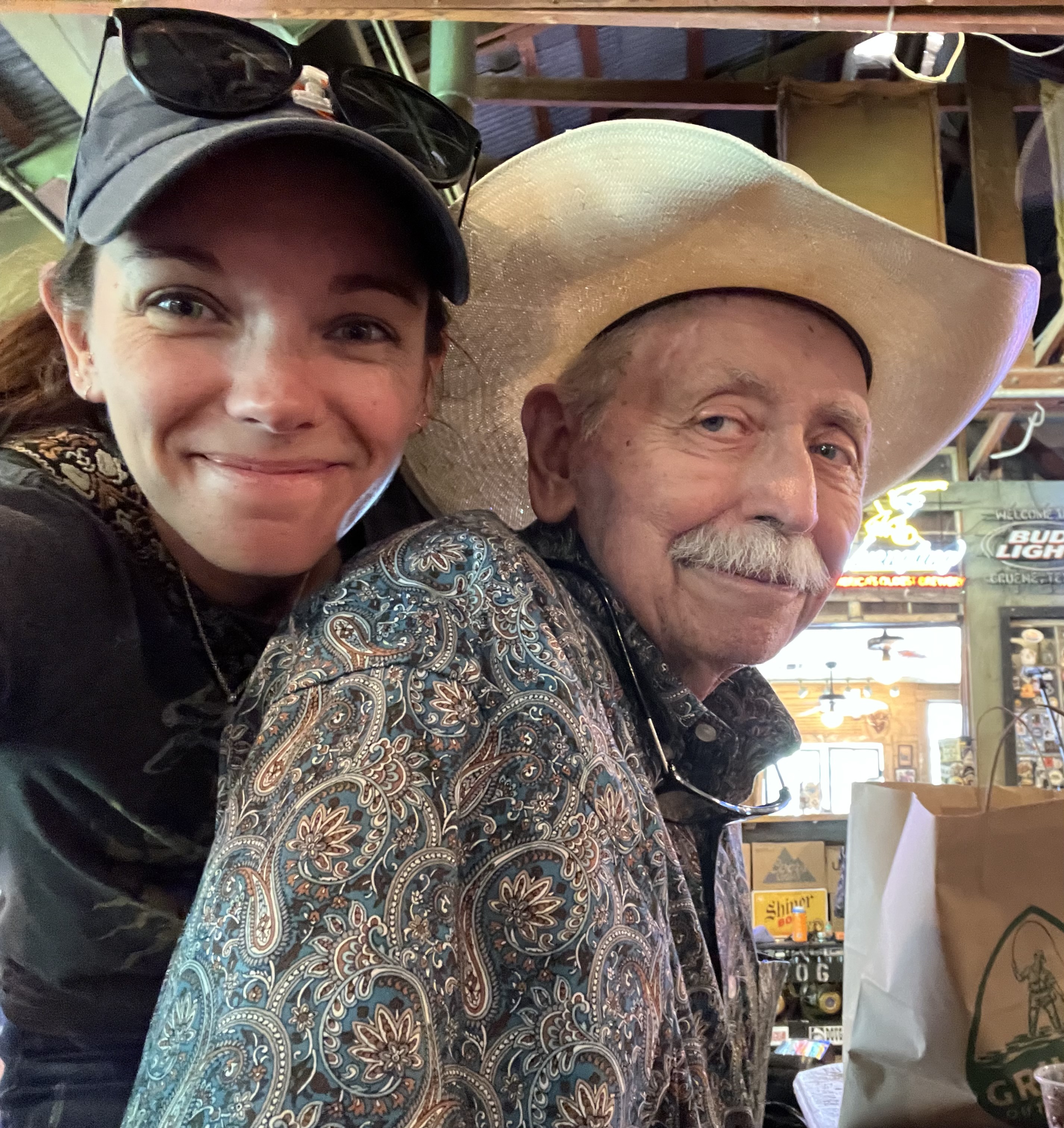
Shannon and her dad — family reunion, 2024
Meet the man who inspired all of this.
My dad is 79 years old. He spent his entire life building things — custom homes, custom cabinets, beautiful spaces that other families got to live in. He was the kind of man who was up before sunrise every single day, worked seven days a week when he needed to, and came home every night to eat dinner with us and watch a movie before doing it all over again.
A few years ago, he was diagnosed with Parkinson's disease. Not the tremor kind most people picture — his affects his speech and his mobility. He falls. He struggles to walk. And he takes a medication called levodopa five times a day that directly affects how well he can move. When he takes it on time, he functions better. When he doesn't, the difference is visible.
The problem I couldn't solve.
I live an hour away from my parents. My mom is his primary caregiver, and the complexity of managing my dad's condition was overwhelming her. I could get to appointments, advocate for him with doctors, do research — but the day-to-day? I couldn't be there for that.
I started searching for an app that my family could use together — something my mom, my brother, and I could all see, all contribute to, all rely on. Something where she could write daily notes — did he fall today? How was his mobility? Did he take his medication? Something I could check from an hour away without having to call every single day and add to her stress.
I couldn't find it. There were apps where two people could share a login, but nothing built for what we actually needed — real collaboration, real shared visibility, real coordination between people caring for the same person from different places.
The moment that broke me a little.
My dad resisted the medications. Five times a day felt like a lot to him — if he was in the middle of something, busy with anything, stopping to take a pill felt like an interruption. He'd snooze the alarm I set on his phone. He'd tell me "I took them early" when I watched him not take them. He'd say "I'll take them in a minute" and then forget.
And I had no way to know. No way to confirm. No way to connect the dots between the days he skipped doses and the days his symptoms were worse. I was trying to explain to him that the medication timing directly impacted his mobility — that this wasn't optional — and I had nothing to show him. No data. No pattern.
My mom eventually burned out and kind of gave up for a while. I understood why. There were no tools making her job easier. There was nothing helping her feel less alone in it.
My brother and I — and what we learned the hard way.
I'm not doing this alone. My brother has been my teammate through all of it — there on the ground when I can't be, on the phone with me when neither of us knows what to do next. When my mom ended up in the hospital for a month-long stay last year, it was the two of us tag-teaming every single day. When the doctors stopped listening, we kept pushing. When something didn't add up, we researched together until it did. There's a particular kind of bond that forms when you've sat in a hospital hallway at 10pm with someone, both of you trying to figure out what the doctors are missing.
What we didn't fully see at first — because we were so consumed with my mom — was what was happening with my dad. His person was gone. The one who managed his medications, his meals, his daily routine — she was in a hospital bed, and he was alone and scared. My brother made sure Dad wasn't by himself — having meals with him, bringing him along to work, checking in every single day. I did the same when I could get down there, or one of us would be at the hospital with Dad sitting by Mom's bed, and the other would be working. One of us would be there to make sure Dad ate something, and to encourage him to go home and rest and that we would stay at the hospital with Mom — the only way Dad would ever agree to leave my Mom was if one of us was there to stay with her.
But it took us longer than it should have to realize he had stopped taking his medications correctly. He was worried about Mom. His routine was shattered. And without any visibility into whether he was actually taking his doses — we could only see that his symptoms were getting worse, and we didn't immediately know why, aside from knowing that stress can aggravate Parkinson's symptoms.
That moment is burned into me. That's the gap CareCircle fills. Not just for the person being cared for — but for the whole family trying to hold everything together at once.
Why I built CareCircle.
I spent eight years as a child protective services social worker. I know what it looks like when systems fail vulnerable people. I know the difference between having the right tools and not having them. And I knew that what my family was experiencing wasn't unique — millions of families were cobbling together alarms and group texts and paper journals trying to manage someone's care, just like we were.
So I decided to build what I couldn't find.
Every single feature in CareCircle exists because I needed it. The family circle — because my mom, my brother, and I needed to see the same information. The symptom and medication correlation tracking — because I needed to show my dad the pattern with his own data. The AI Health Q&A — because I was Googling medical questions at midnight and getting generic results that didn't account for his specific medications and diagnoses. The missed dose alerts — because I needed to know when he skipped, not three days later.
I built this for my dad in his cowboy hat who spent his life building beautiful things and deserves to be cared for with the same level of dedication he gave everything else. And I built it for my mom, who is trying her best every single day.
And I built it for you. Because I know you're going through something like this too.
“You don't have to be a medical professional to give excellent care. You just need the right tools — and someone who built them because they needed them too.”
— Shannon, Founder of CareCircle
What this means for you.
CareCircle was not built to be another app on your phone. It was built to be the thing that actually helps — the tool that makes the impossible feeling of managing someone else's health from a distance feel a little more possible.
Every feature was designed by someone who lived the problem. The AI knows your loved one personally because I needed it to know my dad. The family circle exists because my family needed to be on the same page. The symptom tracking exists because I needed data to have a real conversation with my dad's doctors.
If you're caring for a parent, a partner, a child, or anyone you love — CareCircle was built for exactly the moments you're going through. You're not alone in this. And you shouldn't have to do it without the right tools.
Ready to care smarter?
Join the waitlist for early access and a special offer for founding members.
Join the Waitlist →